
|
| VOL XXVII | ISSUE 15 | 15 August 2026 | Previous Edition |
| HOME | SUBSCRIBE |
| TOP STORIES | POLICY SCAN | PERSPECTIVE | PUBLICATIONS & REPORTS | ELCINA EVENTS | UPCOMING EVENTS |
|
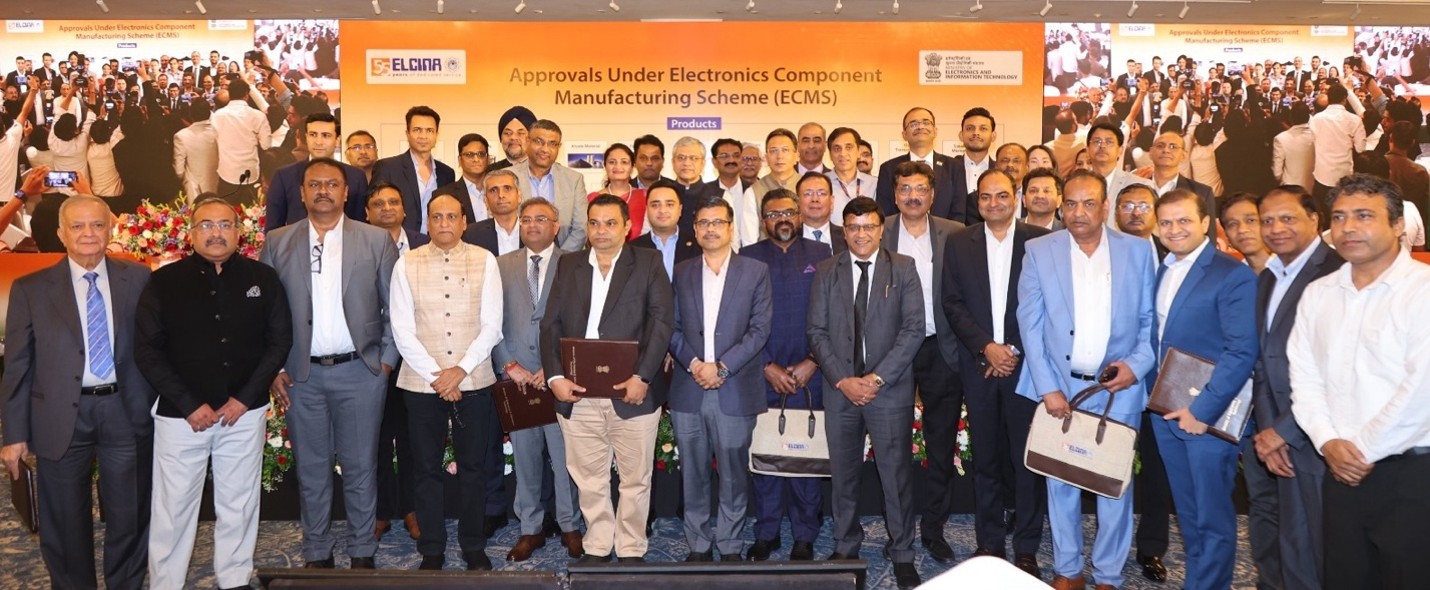
ECLINA & MeitY Host the 5th Tranche ECMS Awards Ceremony Congratulations to the Awardees!
The Electronics Components Manufacturing Scheme (ECMS) has crossed another significant milestone with the Government’s approval of 31 fresh proposals. ELCINA was honoured to host the award ceremony, which was presided over by Shri Ashwini Vaishnaw, Union Minister for Electronics & IT; Shri Jitin Prasada, Minister of State for Electronics & IT; Shri S. Krishnan, Secretary, MeitY; Shri Sushil Pal, Joint Secretary, MeitY; and Dr. Sasikumar Gendham, President, ELCINA.
The Government has approved 31 electronics manufacturing applications across 10 states, involving investments of ₹7,877 crore, projected production of ₹82,243 crore and expected direct employment generation of around 9,588. The approvals cover 20 target-segment products spanning sub-assemblies, bare components, supply-chain products and capital goods.
With the 5th tranche, overall ECMS approvals have reached 106 applications covering 30 products across 15 states, with cumulative approved investments of ₹69,548 crore, projected production of ₹5,34,101 crore and expected direct employment generation of 74,628.
Notably, at ₹69,548 crore, the approved investments under the ECMS have now surpassed the ₹59,350 crore investment target envisaged under the scheme. The approved projects approved in the 5th tranche are spread across Goa, Gujarat, Haryana, Himachal Pradesh, Karnataka, Maharashtra, Tamil Nadu, Telangana, Uttar Pradesh and Uttarakhand, further expanding the geographical footprint of electronics component manufacturing in India.
ELCINA particularly welcomes the progress made under the ECMS, especially as several of its recommendations were incorporated into the scheme by the Government. Equally noteworthy is the pace of implementation. Since the ECMS was notified in April 2025, 106 applications have been approved in less than one and a half years, with cumulative approved investments surpassing the scheme’s initial investment target by over ₹10,000 crore.
This rapid progress reflects the growing confidence of industry in India’s electronics manufacturing potential and the importance of continued Government-industry collaboration in building a deeper, more resilient and globally competitive electronics component ecosystem.
Exclusive Offer of SEMI Member Rate for ELCINA Members at SEMICON India 2026
Offer Open Till Friday 21st August End of Day
Rates can be viewed on the link : https://www.semiconindia.org/exhibitor/exhibit-now Register Before Friday 21st August end of day to avail the exclusive Offer for ELCINA members.
Explore exhibition opportunities: https://www.semiconindia.org/exhibitor/exhibit-now For registration, participation, or discount-related assistance, contact:
|


  ELCINA Directory of Indian Electronics Industry 2025-26 
Companies committed to electronic hardware manufacturing with substantial value addition through production of components, subassemblies, parts, capital goods/machinery for manufacturing of electronics hardware, EMS providers, service providers such as quality/product testing as well as companies designing components and subassemblies are eligible for membership. Equipment companies from all segments of electronics (i.e., Consumer, Telecom, IT, Defence, Industrial, Medical and Automobiles) are welcome to join ELCINA membership once they commence manufacturing, assembling or designing activities in the country. All Payments through local Cheque/Draft favoring ELCINA Display Center 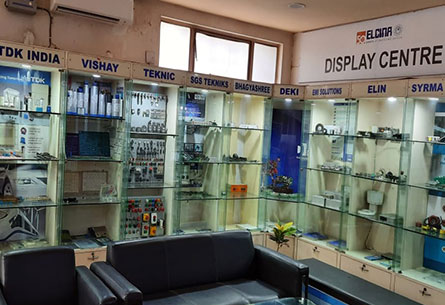
ELCINA has recently renovated its Display Center to meet the changing environment of the Industry. Small size Display booths are made to accommodate more and more companies. Contact: saly@elcina.com |


|
AI boom, West Asia crisis trigger printed circuit board shortage, price rise in electronics industry The Economic Times | 02 August 2026 A global shortage of printed circuit boards (PCBs), driven by the West Asia conflict, AI server demand, and rising raw material costs, is pushing up prices across the electronics industry. According to ELCINA, critical PCB materials such as photoresists and copper clad laminates remain heavily import-dependent, while prices of key inputs have surged sharply since early 2026. The industry has called for faster localisation of raw materials and expedited implementation of approved PCB and copper clad laminate manufacturing projects under the ECMS scheme to strengthen domestic supply chains. China steps up protection for chip designs in revised regulations Reuters | 03 August 2026 China has revised its regulations on integrated circuit (IC) layout designs to strengthen protection of domestic semiconductor innovation. Effective October 15, the new rules raise originality standards, tighten registration requirements, and introduce punitive damages for serious infringement. Applicants must prove designs are genuinely original, while regulators can reject low-quality or bad-faith filings. The regulations also clarify licensing, transfer, and collateral use of layout-design rights. The changes reflect Beijing's growing emphasis on safeguarding indigenous chip technology amid continuing U.S. restrictions on China's semiconductor sector. Lok Sabha passes Taxation Amendment Bill to boost investment, manufacturing, ease of doing business Business Today | 06 August 2026 The Lok Sabha has passed the Taxation and Other Laws (Amendment) Bill, 2026, introducing measures to attract foreign investment, strengthen domestic manufacturing and support India's digital economy. The legislation extends tax exemptions for foreign suppliers of capital goods and equipment used by Indian electronics manufacturers until 2041 and expands eligible products to include laptops, tablets, servers, wearables and hearables. Foreign companies storing components in bonded warehouses will receive a 15-year tax exemption. The Bill also eases requirements for foreign cloud providers using Indian data centres and permits data centres to operate on leased infrastructure. ISM 2.0 will offer 30% capital subsidy, five-year PLI for chip ecosystem The Economic Times | 12 August 2026 Semiconductor materials and equipment manufacturers are expected to receive a 30% capital subsidy and a five-year production-linked incentive under India Semiconductor Mission 2.0. The PLI will be linked to domestic value addition, starting at 10% of domestic bill of materials in the first year and declining to 2% by the fifth year. Overall government support will be capped at 50% of eligible capital expenditure. The framework will cover semiconductor materials, R&D, testing facilities and equipment manufacturing, aiming to deepen India's domestic semiconductor ecosystem.
DGFT Digitises Duty Payment Data for EODC Processing The Directorate General of Foreign Trade (DGFT) has integrated license-wise voluntary duty payment data from Customs/ICEGATE into its online system for processing Export Obligation Discharge Certificate (EODC) applications under the Advance Authorisation and EPCG schemes. For payments made from 1 August 2026, the digitally reflected data on the DGFT portal will serve as the official record, reducing manual documentation and improving transparency, accuracy and paperless processing. Ministry of Commerce & Industry, Department of Commerce, DGFT | Trade Notice No. 15/2026-27 | 05 August 2026 DGFT Introduces Procedures for Exporters-on-Record and Seller-on-Record Procedures have been introduced under Chapter 9 of the Handbook of Procedures for registration and digital record-keeping of Exporters-on-Record and Seller-on-Record. The framework requires registration through ANF-9A, timely reporting of changes, and a digital repository linking procurement, GST and export documents, with Exporters-on-Record responsible for destination-country compliance and related obligations. Ministry of Commerce and Industry, Department of Commerce, DGFT | CG-DL-E-06082026-275234 | 05 August 2026 Anti-Dumping Duty Imposed on Phthalic Anhydride Imports from China and Korea Anti-dumping duty has been imposed on imports of Phthalic Anhydride from China and South Korea, following findings that dumping has continued and that ending the existing duty could lead to renewed injury to the domestic industry. The duty is set at USD 40.08 per MT for imports from China and USD 140.17 per MT for imports from South Korea, and will remain in force for five years. Ministry of Finance, Department of Revenue | CG-DL-E-05082026-275230 | 05 August 2026 Domestic Steel Policy Replaces 50% Value Addition with Melt & Pour Requirement The Domestically Manufactured Iron & Steel Products Policy-2025 has been amended to replace the existing 50% Domestic Value Addition requirement with a Melt & Pour requirement for specified iron and steel products under HS Codes 7301, 7302, 7303 and 7308–7326. The change requires the steel used to meet the prescribed melt-and-pour criteria and the final product to be manufactured entirely in India, while other provisions of the policy remain unchanged. Ministry of Steel | CG-DL-E-11082026-275385 | 07 August 2026
General India's data centre boom faces a gridlock on power infra lag Mint | 03 August 2026 India's rapid expansion of data centers and AI infrastructure is placing growing pressure on the country's power grid, with reliable electricity emerging as a bigger challenge than land acquisition. Industry leaders say delays in building high-voltage substations and transmission lines, due to land, regulatory and right-of-way approvals, are slowing project execution. Strengthening the supporting power infrastructure will require investments running into several lakh crore rupees. While state discoms typically fund substations, developers bear the cost of transmission lines, transformers and internal power distribution. Tax Bill proposes easier norms for data centres, incentives for electronics Business Standard | 04 August 2026 The Taxation and Other Laws (Amendment) Bill, 2026, introduced in the Lok Sabha, is expected to strengthen India's data centre and electronics manufacturing sectors by reducing regulatory barriers and improving tax certainty. Industry experts believe the legislation will make it easier for global cloud service providers to expand operations and encourage foreign suppliers of capital equipment to invest with greater confidence. The proposed changes aim to create a more stable and predictable business environment, enhancing India's appeal as a destination for global investment and manufacturing. Govt weighs PLI 2.0 with sharper focus on high-performing sectors The Economic Times | 05 August 2026 The government is considering a second phase of its production-linked incentive (PLI) programme, focusing on extending support to high-performing sectors while revising or reducing incentives for lower-performing ones. The new schemes are expected to promote domestic manufacturing and import substitution, with changes such as lower investment thresholds, broader product eligibility, and relaxed turnover requirements. Since its launch, the PLI programme has attracted over ₹2.4 lakh crore in investments and generated strong production and export growth, particularly in electronics, IT hardware, advanced batteries, solar PV, and specialty steel. Fujiyama commissions 2 GW power electronics mfg facility at Ratlam The Economic Times - Energy | 08 August 2026
India's data centre capacity surges over four-fold: A 1,575 MW backbone for 'AI and digital India'
Financial Express | 09 August 2026
CXMT Overtakes Tencent to Become Most Valuable Chinese Company
Bloomberg | 13 August 2026
CXMT has surpassed Tencent as China's most valuable company, driven by the AI-fuelled boom in memory-chip demand. The Shanghai-listed chipmaker, now worth US$524 billion despite a 1.2% dip, overtook Tencent's US$510 billion valuation as investors favour AI hardware over traditional internet giants. CXMT, China's top DRAM producer and a symbol of its semiconductor ambitions, soared 467% at debut and remains up 8%. Its inclusion in the MSCI China All Shares Index on Aug 10 has further bolstered momentum. Analysts expect the valuation gap to widen.
Semiconductors Govt raises semiconductor demand forecast 50% to $150 billion by 2030 Business Standard | 02 August 2026
L&T Semiconductor goes local with chip backend, shifts OSAT to India Business Standard | 03 August 2026
An Indian encore, for chips: Meity's semiconductor plan is just beginning Business Standard | 10 August 2026 India has emerged as a significant alternative manufacturing base for Apple, capturing around a quarter of global iPhone production within five years, supported by government incentives. The government now aims to replicate this success in semiconductors, targeting the mature 28-nanometre-and-above chip market, where China dominates. These chips power automobiles, consumer electronics, IoT devices and telecom equipment, representing around 70% of global semiconductor volumes. As the US, Japan and South Korea increasingly concentrate on advanced chips for AI and data centres, India sees an opportunity to become a competitive alternative source for mature-node semiconductors. India's big semiconductor push: PM Modi says 7-8 plants coming up; stresses self-reliance in chips The Times of India | 15 August 2026 India has begun semiconductor production at three facilities, with another seven to eight plants expected to become operational over the next seven to eight years, Prime Minister Narendra Modi said. He highlighted the progress as a major step towards technological self-reliance, noting that semiconductor chips are critical to sectors ranging from electronics and healthcare to transportation. India's second-phase semiconductor mission has received an outlay of ₹1.275 lakh crore, following the ₹76,000 crore allocation under Semicon 1.0. The government has approved 12 semiconductor projects involving investments exceeding ₹1.64 lakh crore.
Information Technology India's IT sector is surviving artificial intelligence The Economist | 06 August 2026 Despite concerns that artificial intelligence could eliminate jobs in India's technology sector, there is little clear evidence of widespread displacement so far. Software development and routine business processes, major areas of India's outsourcing industry, are among the tasks most exposed to AI automation. Employment at major IT companies has declined from 1.71 million in 2023 to 1.66 million in June, but remains 9% above the pre-pandemic trend. Recent reductions also reflect a correction after aggressive pandemic-era hiring. Similar patterns are visible at major foreign technology firms operating in India. H-1B costs soar, prompting Indian IT companies to rethink US hiring Business Standard | 13 August 2026 Indian IT companies sharply reduced new H-1B visa applications for the US FY27, as higher fees and changes to the selection system made overseas hiring more expensive and uncertain. Eligible registrations fell 38.5% to 211,600 from 343,981 a year earlier, reaching at least a seven-year low. Immigration lawyers said some Indian firms reported a 60–70% decline in cap-case volumes, attributing the fall to higher costs, greater weighting for higher-salaried applicants and growing use of artificial intelligence. The peak was 758,994 registrations in FY24.
Consumer Electronics 4G phones get a lifeline as entry-level 5G prices rise The Times of India | 12 August 2026 India's sub-$100 smartphone market is shrinking rapidly as rising memory and component costs make entry-level devices increasingly difficult for manufacturers to sustain. Shipments in the April-June quarter fell 74.3% year-on-year, reducing the segment's market share to 4.5% from 15.6%. Overall smartphone shipments declined 11.1%, but average selling prices rose 14.4% to a record $315 as brands reduced discounts and consumers moved towards more expensive devices. The $100–200 segment remained stable, while shipments in the $400–600 category surged 60.3%, highlighting a broader shift towards higher-priced smartphones. LG Electronics India ramps up production for festival season as demand remains resilient despite price hikes Moneycontrol | 14 August 2026 Consumer demand for electronics and appliances in India remains resilient despite inflation, with buyers increasingly prioritising technology, convenience and overall product experience over price. LG Electronics India expects to absorb rising input costs through operational efficiencies and procurement rather than immediately raising prices. The company believes strong brand trust, innovation and after-sales service have made its products relatively less price-sensitive. Consumer sentiment has also improved ahead of the festive season, while trade inventories remain under control. LG expects a longer festive sales period this year, supported by new product launches and earlier e-commerce promotions.
Telecom Trai proposes QoS norms for 5G network slicing Financial Express | 05 August 2026 TRAI has proposed new quality of service (QoS) standards for 5G network slicing to ensure telecom operators maintain sufficient network capacity while offering dedicated virtual networks for enterprise applications. Operators planning new 5G network slices would be required to submit details of proposed and existing slice parameters at least 21 days before deployment, demonstrating adequate capacity. The regulator has also proposed a new benchmark based on Physical Resource Block (PRB) utilisation to monitor network congestion and ensure enterprise services do not compromise the experience of regular mobile users. Govt mulls single-window clearance for space sector The Economic Times | 14 August 2026 The government is exploring a single-window clearance system for India's space sector to simplify approvals and reduce delays for businesses, including foreign companies. The National Single Window System could potentially be expanded to cover space-sector permissions currently handled by multiple ministries and agencies. The Department of Telecommunications, Ministry of Information and Broadcasting, and IN-SPACe have already discussed an inter-departmental interface for applicants requiring approvals from all three. However, other ministries and security agencies remain involved in the process, particularly for satellite communication services.
EV's & Auto Electronics E-2-wheelers cross 2L mark as EV sales soar The Times of India | 03 August 2026 India's electric vehicle market reached a record in July, with registrations surging more than 66% year-on-year to about 3.3 lakh units, driven by higher fuel prices, a wider range of models, and stronger dealer networks. Electric two-wheelers led the growth, crossing the 2 lakh monthly milestone for the first time and accounting for over 11% of all two-wheeler registrations. TVS Motor remained the segment leader, followed by Bajaj Auto. Electric passenger vehicle registrations eased slightly from June's record but remained well above last year's levels, with Tata Motors retaining market leadership. India's EV charger network crosses 67,600 as FAME-II supports 16.7 lakh vehicles India TV News | 13 August 2026 India had 67,657 electric vehicle (EV) chargers installed across states and Union Territories as of August 7, 2026, including 1,139 battery-swapping station chargers. Government schemes have continued to support EV adoption, with 16.72 lakh EVs sold under FAME-II and 5,299 electric buses deployed by July 2026. The PM E-DRIVE scheme has supported another 26.59 lakh EV sales, while the auto PLI scheme supported 21.30 lakh EVs. The government has also reduced GST on EVs and chargers to 5% and introduced green licence plates with permit exemptions.
Defence & Solar 60% of 2030 target: India hits 300 GW clean energy milestone as solar capacity skyrockets Business Today | 09 August 2026 India crossed 300 GW of installed non-fossil fuel-based electricity capacity as of July 31, 2026, reaching more than 60% of its 500 GW target for 2030. Non-fossil sources now account for over 54% of total installed power capacity, with solar emerging as the main driver after rising to 164.59 GW from just 2.8 GW in 2014. Wind capacity has also expanded significantly. Renewable generation reached 477.79 billion units in 2025-26, while domestic solar module manufacturing capacity has crossed 200 GW. Centre allows renewable developers to cut tariffs after winning tenders Mint | 12 August 2026 The Ministry of New and Renewable Energy has allowed renewable energy developers to voluntarily reduce tariffs after winning tenders, potentially helping unlock around 40 GW of renewable projects awaiting power purchase agreements (PPAs). Renewable energy implementation agencies such as SECI, NTPC, SJVN and NHPC can accept lower tariffs if the reduction is offered independently by the developer, without negotiation or pressure from buyers. The move could make stalled projects more attractive to distribution companies and enable PPAs to be signed without reopening or altering the original tender terms.
MSME India's ₹124.9 trn MSME procurement mkt offers digital growth opportunity Business Standard | 06 August 2026 India's MSMEs are rapidly adopting digital procurement, with four in five businesses expecting online sourcing platforms to support growth over the next three years. A new India SME Forum report estimates the country's MSME procurement economy at ₹124.9 trillion, based on purchasing patterns among 51.53 million Udyam-registered enterprises. The findings highlight growing competition among digital marketplaces, with Amazon Business leading in price transparency and supplier quality, while Moglix ranked highest for industrial procurement and embedded finance. Digital procurement is increasingly seen as a tool to reduce costs, improve efficiency and strengthen supply chains. MSME Amendment Bill 2026 Explained: What changes for corporate payments, disputes and CFOs The Economic Times - CFO | 11 August 2026 The Micro, Small and Medium Enterprises Development (Amendment) Bill, 2026, passed by Parliament, proposes major changes to MSME payments and dispute resolution. It would require Central Public Sector Enterprises to route MSME invoice settlements through the Trade Receivables Discounting System (TReDS) and introduce defined timelines for resolving payment disputes. Buyers challenging awards would still need to deposit 75% of the amount, while courts could direct payment of at least 50% to MSME suppliers if a challenge remains unresolved for over six months. MSME registration would also become free and voluntary.
China's DUV Breakthrough: Why India Must Accelerate its Manufacturing Ambitions
Every milestone in the global semiconductor industry offers an opportunity to learn.
ELCINA EVENTS, ACTIVITIES & SERVICES Webinar : TOP UPCOMING EVENTS & GENERAL INFORMATION DOMESTIC EVENTS
OVERSEAS SHOWS
|
||||||||||||||||||||||||||||||||||


.jpeg)
 Fujiyama Power Systems has commissioned a 2 GW power electronics manufacturing facility at Ratlam, Madhya Pradesh, producing solar inverters, UPS systems and related products. The facility is part of the company's greenfield expansion to build an integrated manufacturing platform for the rooftop solar industry. Its commissioning raises Fujiyama's total power electronics manufacturing capacity to 4.2 GW. The company is also developing battery manufacturing capacity at the Ratlam complex. In May, it commissioned a separate 2 GW solar panel manufacturing facility at the same location.
 India's data centre capacity has expanded more than four-fold, from around 375 MW in 2020 to nearly 1,575 MW, driven by rising demand for cloud services, artificial intelligence and high-performance computing. Private companies, supported by domestic and international investment, are leading the expansion. Mumbai, Chennai, Hyderabad, Bengaluru, Delhi-NCR and Gujarat remain major hubs, while states such as Andhra Pradesh, Madhya Pradesh, Chhattisgarh and West Bengal are emerging destinations. Major projects are focusing on hyperscale infrastructure, AI workloads, reliable power, renewable energy and advanced cooling systems.
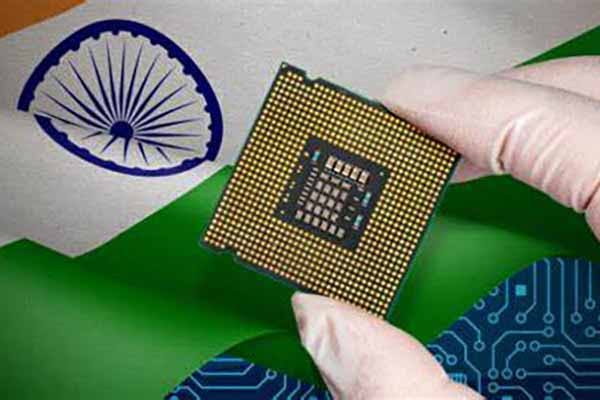 India's semiconductor demand is now projected to reach $150 billion by 2030, 50% above the previous estimate, driven by rapid electronics manufacturing growth and rising AI and data-centre demand. The government expects domestic semiconductor facilities to meet 20–30% of this requirement, with one fabrication plant and 12 OSAT/ATMP units receiving incentives. Three facilities operated by Micron Technology, Kaynes Technology and CG Power are already operational. India is also emerging as an alternative global chip assembly base alongside Malaysia, attracting companies seeking capacity for international markets.
 L&T Semiconductor Technologies (LTSCT) is shifting part of its outsourced semiconductor assembly and testing (OSAT) operations from overseas to India, citing the growing global cost competitiveness of Indian packaging companies. The company is already working with Tata Electronics, while Indian OSAT players currently cover about 50 of the 500 semiconductor package types. LTSCT continues to manufacture its chip designs in fabs in the US, Taiwan and Japan. It may shift fabrication to Tata Electronics' planned Indian fab if pricing is globally competitive.


%20scheme.jpg)








|
A newsletter published by ELCINA, New Delhi. The information contained in this newsletter is for private circulation only. Despite our best efforts, some errors could have crept in. You are advised to verify authenticity of the information before further use. Electronic Industries Association of India (ELCINA) ELCINA House, 422 Okhla Industrial Estate, Phase-III, New Delhi 110020 (India). E-Mails: info@elcina.com Tel: 011-41615985, 41011291 Website: www.elcina.com |