|
Extension of timelines for implementing the Order covering
product categories listed in the CRO schedule under S.O.
1929(E)
The implementation date for compulsory BIS
registration of “Television Sets” (Sl. No. 64 of the
Electronics and IT Goods CRO, 2021) for compliance with IS
18112:2022 has been extended from 26 January 2026 to 26 July
2026.
Ministry of Electronics and Information
Technology | Notification No. CG-DL-E-22012026-269529 | 22
January 2026
Standard for telecommunication equipment (generic
requirements IoT Gateway)
The notification brings three updated TEC
technical standards into force for telecom equipment –
covering splice closures for optical fibre cables, lightning
and surge protection of telecom sites, and SMPS-based power
plants – under the Telecommunication Act, 2023 and related
rules, effective from the Gazette publication date.
Ministry of Communications, Department of
Telecommunications | Notification No.
CG-DL-E-24012026-269578 | 23 January 2026
Telecommunication Engineering Centre notifies revised
telecom equipment standards
The Ministry of Communications announced
revised standards for telecommunication equipment. This
update aligns with ongoing efforts to modernize India's
telecom certification framework under the MTCTE regime,
ensuring enhanced compliance, interoperability, and safety
for devices like IoT gateways and active DAS systems.
Ministry of Communications, Department of
Telecommunications | Notification No.
CG-DL-E-24012026-269577 | 23 January 2026
TOP
INDUSTRY SCAN
General
Not fabs, but fundamentals: Why India-Germany’s chip pact
could reshape New Delhi’s semiconductor ambitions
Business Today
| 16 January 2026
India and Germany have elevated their
relationship from a transactional buyer – seller model to a
strategic technology partnership by signing a Joint
Declaration of Intent on the India-Germany Semiconductor
Ecosystem Partnership during Chancellor Friedrich Merz’s
visit. The framework aims to combine Germany’s industrial
strengths with India’s ambition to build a domestic
semiconductor base. The partnership recognises that building
a chip industry goes beyond fabs, focusing on equipment,
chemicals and precision engineering where Germany holds key
expertise.
Read More
India
Inc shows interest for Rs 7,280-crore rare earth
magnet scheme
Financial
Express | 16 January 2026
India’s largest industrial groups, including
Adani Enterprises, Reliance Industries, JSW Group, Kalyani
Group and Maruti Suzuki India, have expressed early interest
in the government’s ₹7,280-crore incentive scheme to build
domestic capacity for rare earth permanent magnets. Company
representatives attended a recent stakeholders’ meeting to
understand the scheme, which aims to support the full
manufacturing chain from rare earth processing to finished
magnets. However, firms are waiting for the final request
for proposal before committing investments, after assessing
incentives against their business needs.
Read More
India
holds ground in US market as electronics and consumer goods
blunt tariff impact
Moneycontrol |
16 January 2026
Despite higher US tariffs, India has largely
maintained and in some cases expanded its presence in the
American market, supported by strong electronics and
consumer goods exports. A Moneycontrol analysis shows nearly
60 percent of Indian products imported by the US saw higher
volumes and increased import share after tariffs were
imposed. The impact has been uneven across categories, with
electronics showing exceptional resilience. Laptop exports
surged sharply, reflecting India’s ability to quickly scale
manufacturing and benefit from global supply-chain shifts
away from competing countries.
Read More
Kaynes Semicon Signs Fiscal Support Pact Under India
Semiconductor Mission
CXO Today | 17
January 2026
Kaynes Semicon Private has executed its
Fiscal Support Agreement and related transaction documents
with the India Semiconductor Mission, Government of India.
This marks a key procedural milestone enabling eligible
fiscal support under the national semiconductor policy
framework. The development reflects the government’s
continued commitment to building domestic semiconductor
manufacturing capabilities and highlights Kaynes Semicon’s
focus on strong governance, transparency, compliance, and a
leadership role aligned with India’s long term strategic
objectives.
Read More
Electronics firms seek duty cuts to boost local
manufacturing
Financial
Express | 19 January 2026
Electronics manufacturers have urged the
government to rationalise customs duties in the Union
Budget, arguing that changes to tariffs on components and
capital equipment are essential to sustain India’s mobile
phone and electronics manufacturing growth. In proposals
submitted by industry body ICEA, the sector has highlighted
cost disadvantages faced by domestic manufacturers due to
current duty structures. Addressing these issues, it says,
would improve global competitiveness and help India attract
and retain supply chains as multinational companies
diversify production beyond China.
Read More
Davos 2026: India is emerging as a manufacturing hub
for electronics, Qualcomm CEO says

The Economic
Times | 22 January 2026
India is emerging as a major global hub for
electronics manufacturing as companies diversify production
away from China to countries like India and Vietnam.
Qualcomm CEO Cristiano Amon, speaking at the World Economic
Forum 2026 in Davos, said this shift is driven by economic
efficiency and the need to reduce political and supply-chain
risks. The pandemic reinforced the importance of diversified
manufacturing bases. India’s expanding electronics sector
presents strong potential for investment and job creation,
strengthening its role in global supply chains.
Read More
1st
Commercial Semiconductor Chip Production Will Begin This
Year: Minister
NDTV | 24
January 2026
Union Electronics and Information Technology
Minister Ashwini Vaishnaw said India is on track to begin
commercial semiconductor chip production in 2026, in line
with the timeline set under the India Semiconductor Mission
launched in January 2022. The government had targeted
commercial output within five years of the mission’s
rollout. According to the minister, four semiconductor
plants are expected to begin operations in 2026, while pilot
production has already started at three facilities in 2025,
marking steady progress toward building domestic chip
manufacturing capacity.
Read More
Bharat Electronics net rises 21% to ₹1,580 crore in Q3FY26
.png)
The Economic
Times - Manufacturing | 29 January 2026
State-owned defence major Bharat Electronics
Ltd (BEL) posted a strong performance in the December
quarter, supported by steady defence demand and a robust
order book. Consolidated net profit rose 21 per cent
year-on-year to ₹81,580 crore in Q3 FY26, while revenue from
operations grew 24 per cent to ₹27,154 crore. The company
also delivered sequential growth, with profits improving
from the September quarter and revenues rising from ₹5,946
crore, reflecting consistent execution across key defence
programmes.
Read More
TOP
Information Technology
AI adoption outpaces training, 71% professionals expect role
shifts: Report
Business
Standard | 18 January 2026
Artificial intelligence adoption in
workplaces is advancing faster than corporate training
efforts, creating a growing skills gap, according to a
Genius HRTech and Digipoll report. About 71 per cent of
professionals expect their roles to change in the coming
years as AI tools and workflows become mainstream. However,
61 per cent said their organisations have not provided
adequate guidance on effective AI use, while only 37 per
cent reported receiving proper training. The findings are
based on a November 2025 survey of 1,704 professionals.
Read More
India’s big IT ends recruitment freeze, but only for niche
skills
The Economic
Times | 18 January 2026
India’s top five IT companies added a net
2,505 employees in calendar year 2025, reversing job cuts
made the previous year and signalling a shift towards
selective, skill-based hiring. The firms—TCS, Infosys,
HCLTech, Wipro and Tech Mahindra—had reduced headcount by
about 2,500 in 2024 after trimming excess workforce built
during the pandemic. Despite employing over 1.5 million
people, the $283 billion IT sector has not returned to
earlier hiring levels amid AI-driven disruption and the rise
of global capability centres.
Read More
TOP
Consumer Electronics
From factory floors to AI labs: Samsung’s JB Park on
creating ecosystem of industrial design in India

The Indian
Express | 19 January 2026
Samsung’s push to blend design with software,
AI, and automation reflects India’s growing importance as a
global technology and innovation hub. Like other major tech
firms, Samsung is increasing its focus on India due to the
country’s large consumer market, rising exports, and strong
foreign investment inflows. As companies diversify supply
chains away from China, India has emerged as the world’s
second-largest mobile phone manufacturer. However, gaps
remain in the end-to-end ecosystem, which Samsung aims to
address through greater local design.
Read More
Surging memory chip prices dim outlook for consumer
electronics makers
The Economic
Times - CIO | 22 January 2026
Global demand for smartphones, personal
computers and gaming consoles is expected to decline this
year as rising memory chip prices force companies to
increase retail prices. Rapid investment in artificial
intelligence infrastructure by US tech giants has absorbed a
large share of global memory supply, driving manufacturers
to prioritise higher-margin data centres over consumer
electronics. Major chipmakers Samsung, SK Hynix and Micron
are struggling to meet demand amid surging prices. As a
result, research firms now forecast a contraction in
smartphone shipments, reversing earlier growth expectations.
Read More
TOP
Telecom
India,
Germany ink pact to deepen collaboration in telecom & ICT
domains
The Economic
Times - Telecom | 16 January 2026
India and Germany have signed a Joint
Declaration of Intent to strengthen cooperation in telecom
and information and communication technology, according to
the Ministry of Communications. The agreement creates a
framework for regular consultations, annual high-level
meetings, and working groups involving government, industry,
academia, and research institutions. It focuses on sharing
best practices, collaboration in emerging technologies, and
cooperation in policy, manufacturing, and ease of doing
business. The pact was signed during German Chancellor
Friedrich Merz’s official visit to India.
Read More
India
is now the 2nd largest 5G user with 400 million+ users
globally: Jyotiraditya Scindia

The Economic
Times | 16 January 2026
India has emerged as the world’s
second-largest 5G market after China, with over 400 million
subscribers, according to Union Communications Minister
Jyotiraditya Scindia. Launched in 2022, 5G services now
cover 99.6% of districts and reach about 85% of the
population. Telecom operators have installed 4.69 lakh 5G
base transceiver stations, marking one of the fastest
rollouts globally. Around 250 million users have adopted 5G
so far, while rural telecom connections have grown sharply,
outpacing urban growth.
Read More
Centre delicenses lower 6 GHz band for faster Wi-Fi at homes

The Economic
Times | 22 January 2026
The government has delicensed the lower
portion of the 6 GHz spectrum band, enabling faster home
Wi-Fi speeds and supporting next-generation technologies
such as Wi-Fi 7 in India. The move, welcomed by the
technology and electronics industry, follows a notification
by the Ministry of Communications exempting low-power indoor
and very-low-power outdoor wireless access systems from
licensing. The exemption covers devices operating in the
5925-6425 MHz band on a shared, non-interference basis,
subject to compliance with prescribed technical limits on
power, bandwidth and emissions.
Read More
Economic Survey highlights telecom PLI's big success
The Economic
Times | 29 January 2026
India’s telecom sector has recorded strong
gains under the PLI scheme, with exports growing at a 1.5%
AAGR between FY21 and FY25, while imports declined 18.5%,
according to the Economic Survey 2025-26. Launched in 2021,
the scheme has drawn over ₹4,700 crore in investments, with
telecom exports surging 51.2% in FY25 alone. Telecom now
contributes 1.2% to GVA. Rising connectivity, falling data
prices, rapid network expansion and public programmes like
BharatNet have driven digital adoption, especially in rural
areas.
Read More
TOP
EV’s & Auto Electronics
Ola Electric expands 4680 Bharat Cell platform beyond EVs,
enters residential energy storage and B2B supply

Fortune India
| 16 January 2026
Ola Electric has announced a major expansion
of its in-house 4680 Bharat Cell platform, positioning it
beyond electric mobility to serve residential energy storage
and B2B applications. Unveiled at the ‘Prarambh 2026’ event,
the move marks Ola’s entry into India’s residential BESS
market and enables direct sales of cells and 1.5 kWh battery
packs to businesses and startups. The strategy aims to
monetise its cell manufacturing across sectors such as EVs,
drones, robotics and medical devices.
Read More
BYD
may begin electric vehicle assembly in India: Here’s why
The Times of
India | 28 January 2026
Chinese electric vehicle maker BYD is
exploring local assembly options in India as strong demand
for its cars runs up against import limits and supply
constraints. According to reports, the company is evaluating
semi-knocked-down (SKD) assembly routes after India rejected
its proposal for a full manufacturing plant due to concerns
over Chinese investments. SKD assembly requires lower
investment and faces fewer regulatory hurdles. With bookings
running high and sales up 88 per cent last year, local
assembly could ease tariffs, improve pricing flexibility,
and support higher volumes.
Read More
Economic Survey 2026: Auto sector gets over ₹35,600 crore
PLI investment, 49,000 jobs created
CNBC TV18 | 29
January 2026
India has rolled out multiple schemes to
strengthen its electric and advanced automotive ecosystem.
The PLI Scheme for Automobiles and Auto Components, launched
in 2021, has drawn ₹35,657 crore in investment and generated
nearly 49,000 jobs, while the ACC battery PLI aims to
localise battery manufacturing with 40 GWh capacity awarded
so far. Complementary initiatives such as PM E-DRIVE, PM
e-Bus Sewa PSM and the SMEC scheme support EV demand, public
transport electrification, charging infrastructure, and
phased domestic manufacturing.
Read More
TOP
Defence & Solar
Reliance commissions solar cells, scales batteries; eyes
green fuel exports to Japan, Korea, Europe

Moneycontrol |
16 January 2026
Reliance Industries’ new energy business is
transitioning from construction to commissioning, with key
milestones disclosed in its Q3 FY26 presentation. The
company has commissioned its heterojunction solar cell
manufacturing in Jamnagar and begun ramp-up, while solar
module operations have achieved 94-95 percent yields for the
first time. Reliance is building an integrated solar value
chain from polysilicon to modules with 10 GW capacity,
scalable to 20 GW, to mitigate supply-chain and geopolitical
risks.
Read More
Defence Procurement Board clears proposal for 114 Rafale
jets
The Times of
India | 17 January 2026
India has moved closer to acquiring 114
Rafale fighter jets after the Defence Procurement Board
cleared the proposal, marking the first formal step in what
could become the country’s largest-ever defence deal, valued
at about ₹3.25 lakh crore. The proposal will now go to the
Defence Acquisition Council and then the Cabinet Committee
on Security. The deal is expected to proceed via an
inter-governmental agreement with France.
Read More
Indian defence company to invest ₹500 cr in chip plant
The Economic
Times | 19 January 2026
Paras Defence and Space Technologies Ltd is
investing ₹500 crore to set up a new semiconductor
production facility aimed at serving both domestic and
export markets, with production expected to begin by the end
of next year. The facility will focus on chiplet integration
and advanced system-in-package technologies, areas where
India currently depends entirely on imports. The company
sees strong domestic demand driven by defence indigenisation,
particularly for thermal imaging systems, with an estimated
annual requirement of ₹2,500 crore for sensors and chipsets.
Read More
India, UAE to elevate ties with strategic defence
partnership
The Times of
India | 20 January 2026
India and the UAE further deepened their
rapidly expanding partnership with the signing of a letter
of intent for a strategic defence partnership during
President Mohamed bin Zayed Al Nahyan’s brief visit to
India. The visit yielded multiple outcomes, including four
additional agreements covering space cooperation, a
long-term LNG supply deal between HPCL and ADNOC Gas, and
development of the Dholera Special Investment Region. The
two sides also announced plans to double bilateral trade to
$200 billion by 2032 and expand cooperation in
supercomputing and civil nuclear energy.
Read More
Boost
for defence exports as Rajnath flags off 1st batch of Pinaka
guided rockets for Armenia
The Times of
India | 20 January 2026
India marked a major milestone in defence
exports as defence minister Rajnath Singh flagged off the
first batch of guided Pinaka rocket systems to Armenia from
a Nagpur facility. The export highlights India’s growing
role as a supplier of advanced weapon systems, with Pinaka
variants capable of striking targets up to 75 km and trial
versions reaching 120 km. Singh said defence exports have
surged to ₹24,000 crore from under ₹1,000 crore a decade
ago, driven by private sector participation and rising
domestic production.
Read More
TOP
MSME
MSME loans of over Rs 52,300 cr sanctioned by PSBs under
digital credit model
The Economic
Times | 19 January 2026
India’s micro, small, and medium enterprises
(MSMEs) are playing an increasingly important role in the
economy, with their contribution to GDP rising steadily. The
sector has also recorded a sharp surge in exports,
reportedly tripling over recent years, reflecting improved
competitiveness and stronger global integration. At the same
time, non-performing asset (NPA) levels linked to MSMEs have
declined, indicating healthier balance sheets and better
credit discipline. Together, these trends highlight the
sector’s growing resilience and importance to economic
growth.
Read More
Centre weighs scaling up MSME Champions Scheme outlay
ninefold to ₹10,000 crore
Mint | 20
January 2026
The Centre is considering a major expansion
of the MSME Champions Scheme, with the budgetary outlay
likely to rise to around ₹10,000 crore over the next five
years. This marks a sharp increase from the ₹1,125 crore
allocated during FY22-FY26 and reflects industry demands for
stronger financial support. The enhanced funding aims to
promote cleaner manufacturing practices, boost exports, and
improve the global competitiveness of small businesses. The
proposal has reportedly reached the Expenditure Finance
Committee stage for approval.
Read More
MSMEs’
contribution to GDP rises, exports triple, and NPA levels
drop
The Times of
India | 20 January 2026
India’s micro, small, and medium enterprises
(MSMEs) are playing an increasingly important role in the
economy, with their contribution to GDP rising steadily. The
sector has also recorded a sharp surge in exports,
reportedly tripling over recent years, reflecting improved
competitiveness and stronger global integration. At the same
time, non-performing asset (NPA) levels linked to MSMEs have
declined, indicating healthier balance sheets and better
credit discipline. Together, these trends highlight the
sector’s growing resilience and importance to economic
growth.
Read More
PLI
and improving demand to favour electronics MSMEs
Business
Standard | 28 January 2026
India’s electronics MSMEs are expected to see
double-digit growth, supported by the PLI-led manufacturing
push and improving domestic demand. Electronics consumption
is projected to rise 11-13% year-on-year to ₹17-18 trillion
this financial year, driven by government demand-boosting
measures, GST rationalisation and income tax revisions.
Mobile phones, consumer and industrial electronics together
account for over half of total sales. Next year, consumption
growth may strengthen further, while electronics production
is expected to rise 10-20% year-on-year under the PLI
scheme.
Read More
TOP
Economic Survey
2025-26: Highlights & Analysis
The Economic Survey 2025-26, tabled by the
Hon’ble Finance Minister Smt. Nirmala Sitharaman in
Parliament on January 29, 2026, provides a practical
framework for navigating a challenging global environment.
With ongoing geopolitical shifts, trade frictions and
supply-chain disruptions, the Survey argues for timely
decision-making, measured risk-taking and the ability to
adjust policies as conditions change, rather than delaying
action through over-analysis.
Despite global uncertainties – including the
imposition of US tariffs in April 2025 – India’s economic
resilience after the Covid-19 pandemic remains visible.
Growth is projected at over 7% in FY26, supported by
continued reforms, government-led momentum and strong
macroeconomic buffers. Together, these factors position
India as a relatively stable economy at a time of global
volatility.
The Survey also acknowledges that India’s
development path cannot follow standard global models. With
a population of 145 crore operating within a democratic
framework, India must build its own approach to growth. This
requires a focus on supply stability, diversified trade
routes, adequate liquidity and strong buffers to manage
external shocks while sustaining long-term competitiveness.
Within this broader context, the electronics
sector assumes added importance. As one of the
fastest-growing segments of manufacturing and exports,
electronics plays a key role in strengthening supply chains,
expanding value addition and building technological
capability. The Survey’s focus on domestic manufacturing,
deeper value chains and strategic autonomy has direct
implications for the future of the electronics industry.
The following analysis outlines the key
takeaways from the Economic Survey 2025-26 from the
perspective of the electronics ecosystem and its
contribution to India’s long-term growth under the vision of
Viksit Bharat 2047.
1.
Electronics
Emerges as a Core Growth Engine
The Economic Survey 2025-26 positions
electronics as a cornerstone of India’s industrial
transformation and global trade strategy. The sector has
undergone a structural shift – from a largely
domestic-focused industry to one deeply integrated with
global value chains. Between FY22 and FY25, electronics rose
from the 7th-largest export category to the 3rd-largest and
fastest-growing, underscoring its strategic importance to
India’s manufacturing-led growth model.
This recognition strengthens the industry’s
long-standing position that electronics must be treated as a
strategic sector with long-term policy continuity. Stable
multi-year frameworks are critical for sustaining
investments in capital-intensive manufacturing and global
supply chain integration.
2. Strong
Production and Export Momentum
The growth momentum in electronics
manufacturing has remained robust:
-
FY25
electronics production: Rs 11.3 lakh crore (19% YoY
growth)
-
FY25
electronics exports: Rs 3.3 lakh crore (37.5% YoY
growth)
-
FY25
imports: Rs 8.4 lakh crore (15% YoY growth)
In the first half of FY26, electronics
exports reached USD 22.2 billion (Rs 2.04 lakh crore),
placing the sector on track to become India’s second-largest
exported item, after engineering goods.
The export surge confirms global confidence
in India’s manufacturing capabilities. However, the parallel
rise in imports highlights the need to accelerate
localisation of components and sub-assemblies to improve
domestic value addition and trade balance.
3.
Mobile Manufacturing: The Central Growth
Driver
Mobile phones continue to be the backbone of
electronics manufacturing growth. Production value increased
nearly 30-fold, from Rs 18,000 crore in FY15 to Rs 5.45 lakh
crore in FY25. India has transitioned from being a net
importer to the world’s second-largest mobile phone
manufacturer. Manufacturing infrastructure expanded from 2
units in 2014 to over 300 units today. This scale-up has
significantly altered India’s position in global electronics
manufacturing.
Mobile manufacturing has successfully created
scale, employment and export momentum. The industry’s next
priority is to deepen the ecosystem beyond assembly by
expanding component manufacturing, tooling, precision
engineering and product-level innovation.
At present, mobile manufacturing is led by
large scale assembly with significant dependence on imported
components with limited domestic value addition. Bridging
this gap is a key challenge and will require sustained
investment across the component ecosystem, materials and
technology transfer. Initiatives such as the Electronics
Component Manufacturing Scheme (ECMS) and the India
Semiconductor Mission (ISM) are targeted to effectively
overcome this weakness and have received a very encouraging
response from industry. ELCINA and industry at large are
confident that overall value addition will rise
significantly from the present 15-20% to 35-40% by 2030.
4. Production-Linked Incentive (PLI) Scheme:
Overall Impact
Since its launch in 2020, the PLI framework
has delivered measurable outcomes across sectors:
-
Actual investments: Over Rs 2 lakh crore
-
Incremental production and sales: Rs 18.7
lakh crore
-
Exports generated: Rs 8.2 lakh crore
-
Employment created: Over 12.6 lakh jobs
(direct and indirect)
-
Incentives disbursed: Rs 23,946 crore
-
Applications approved: 806 across 14
sectors
The Survey identifies electronics as the
flagship success story of the PLI programme.
PLI has demonstrated that outcome-linked
incentives can effectively crowd in private investment. The
success reinforces the electronics industry’s view that
predictable, performance-based policy instruments are
essential for building globally competitive manufacturing
ecosystems.
5. PLI for Large-Scale Electronics
Manufacturing
Launched in April 2020, this scheme has been
central to India’s mobile manufacturing expansion. As of
September 2025:
-
Investment: Rs 13,759 crore
-
Cumulative production: Rs 9.34 lakh crore
-
Exports: Rs 5.12 lakh crore
The scheme successfully encouraged major
global smartphone manufacturers to relocate production to
India, strengthening the country’s role in global supply
chains.
The PLI scheme delivered high returns
relative to incentive outlay. With the original tenure
ending in March 2026, industry emphasises the importance of
continuity to avoid disruption of established supply chains
and long-term export commitments.
6. PLI 2.0 for IT Hardware
The IT Hardware PLI, launched in May 2023,
has begun contributing to diversification beyond mobiles.
As of September 2025:
The scheme supports domestic manufacturing of
laptops, servers, tablets and related hardware.
While early progress is encouraging, this
segment is still at an early stage. Achieving scale
comparable to mobile manufacturing will require stronger
demand creation, faster approvals and alignment with
government procurement. At the same time, greater industry
participation and stronger market linkage are essential, as
wider acceptance of products manufactured in India continues
to evolve. Encouraging and persuading global companies and
multinational manufacturers to expand production in India
will require sustained policy support and targeted
incentives to accelerate scale and market integration.
7. Tariff Rationalisation for Global Value
Chain Integration
The Economic Survey notes that ongoing
geopolitical realignments and global supply-chain
restructuring are opening opportunities for labour-abundant
economies to position themselves as competitive
manufacturing and assembly hubs within global value chains.
However, higher import tariffs on intermediates and capital
goods compared to finished products can create inverted duty
structures, raising input costs and discouraging domestic
manufacturing. Recent Union Budgets have initiated
corrections in several core sectors to move toward greater
tariff neutrality.
For electronics industry, input tariff
neutrality is critical to cost competitiveness and scale.
Continued rationalisation of duties on intermediates and
capital goods—particularly in high-growth segments—can lower
production costs, encourage component localisation, and
strengthen India’s position as a preferred global
manufacturing base
8. Government-Led Electronics Cluster
Development
The EMC and EMC 2.0 schemes focus on creating
plug-and-play infrastructure to support electronics
manufacturing. In electronics manufacturing clusters such as
Noida and Sriperumbudur, public policy has played an active
role beyond regulation. Government interventions have
supported cluster formation by facilitating coordination
among manufacturers, enabling early-stage investments,
guiding procurement and export linkages, and helping small
and mid-sized firms meet global quality and compliance
standards.
For the electronics sector, cluster-based
development has been critical in reducing entry barriers and
accelerating scale. Policy-led coordination helps align
anchor units and suppliers, lowers risk for new investments,
and enables MSMEs to integrate into global value chains.
Strengthening such cluster ecosystems remains essential for
building depth, competitiveness and long-term manufacturing
resilience.
9. Strengthening the Component Ecosystem:
SPECS
To deepen localisation, the Scheme for
Promotion of Manufacturing of Electronic Components and
Semiconductors (SPECS) offers a 25% incentive on capital
expenditure. SPECS plays a critical role in addressing
component-level gaps within the electronics value chain.
Progress so far:
SPECS addresses a critical gap in India’s
electronics value chain. Further impact can be achieved
through faster disbursal timelines, broader product coverage
and stronger integration with anchor manufacturers.
10. Electronics Component Manufacturing
Scheme (ECMS)
Notified in April 2025 with a budgetary
outlay of ₹22,919 crore, ECMS aims to strengthen India’s
electronics component manufacturing ecosystem and improve
integration with global value chains. The scheme provides a
flexible incentive framework, including turnover-linked
incentives, capital expenditure (capex) incentives, and a
hybrid model combining both, across identified target
segment products.
Beyond the Economic Survey, ELCINA notes that
ECMS, conceived by its leadership, is a very important
scheme and has received strong response from the industry.
There is clear investment interest, and the scheme should
continue to receive policy support. Extending it further
will help ensure that these investments lead to real
manufacturing outcomes. Along with the India Semiconductor
Mission (ISM), ECMS can help India move much ahead of its
current 15-20% value addition and a strategic share in the
global electronics value chain.
The ECMS scheme supports manufacturing of key
non-semiconductor components such as PCBs, capacitors,
electromechanical components, camera modules, lithium cells
among others. So far, Rs 54,567 crore of investment has been
approved across 46 projects, with expected production of Rs
2.58 lakh crore and creation of around 51,000 jobs.
11.
Semiconductor
Dependency: A Key Structural Challenge
Despite strong gains in electronics assembly
and exports, the Economic Survey flags a persistent
dependence on imported semiconductors.
Key concerns:
Semiconductors remain the most expensive and
technologically complex component in electronics
manufacturing. This dependency poses risks to long-term
resilience and value addition.
This remains the single largest constraint on
increasing domestic value addition. Without local
semiconductor availability, manufacturers face cost
volatility, supply risks and limited ability to move up the
value chain.
12. Semiconductor Supply Chains: Strategic
Priority
The Economic Survey highlights that globally,
countries are prioritising strategic sectors such as:
-
Semiconductors
-
Artificial
intelligence
-
Electric
vehicles
-
Renewable
energy
-
Critical
minerals
The COVID-19 pandemic exposed severe
vulnerabilities when chip shortages affected over 169
industries worldwide, leading to production disruptions and
cost escalation. The absence of a stable semiconductor
supply is identified as a systemic risk to economic
activity.
For electronics manufacturers, reliable chip
supply is now a competitiveness issue rather than a cost
consideration alone. Domestic semiconductor capacity will be
critical for production continuity, export reliability and
investor confidence.
13. India Semiconductor Mission (ISM):
Building Domestic Capability
Launched in 2021, the India Semiconductor
Mission (ISM) aims to establish domestic capabilities across
design, fabrication and packaging. Under the Rs 76,000 crore
semiconductor programme, key approvals include:
-
Micron’s
ATMP facility
-
Tata
Electronics’ semiconductor fab
-
One
compound semiconductor fab
-
Multiple
advanced packaging units
In addition:
-
24
projects approved for financial support
-
100
companies supported for chip design infrastructure,
including start-ups and MSMEs
ISM is welcome as a decisive step toward
technological sovereignty. Timely execution, skilled
workforce development and ecosystem readiness will determine
whether these projects translate into sustainable
manufacturing capability.
14. Scale of Semiconductor Investments
As of August 2025:
-
10
semiconductor manufacturing and packaging projects
approved
-
Cumulative
investment: Approximately Rs 1.6 lakh crore
-
Projects
spread across six states
As execution accelerates, these investments
are expected to strengthen domestic capabilities and improve
supply-chain resilience, the Economic Survey notes.
The scale of investment reflects strong
global and domestic confidence. Industry stresses the
importance of coordinated centre-state implementation,
infrastructure readiness and long-term policy assurance to
ensure successful commissioning.
15. Policy Continuity and the Road Ahead
With the original six-year mobile PLI scheme
approaching its March 2026 deadline, the government has
significantly increased budgetary support – PLI allocation
nearly doubled to about Rs 8,900 crore in FY26, compared to
FY24. The Survey indicates that the government is evaluating
a successor framework or PLI 2.0, aimed at protecting gains
already achieved and supporting deeper manufacturing and
value addition.
The increased allocation signals policy
commitment. Industry strongly supports a next-phase
framework focused on higher value addition, component depth,
design capabilities and export competitiveness rather than
volume-led assembly alone.
16.
From “Swadeshi” to Strategic Resilience
The Economic Survey concludes that India’s
electronics sector is evolving beyond import substitution
toward strategic resilience. By combining scale
manufacturing, export integration and early-stage
semiconductor capacity building, India is positioning itself
as an indispensable hub in global electronics value chains,
with long-term implications for technology sovereignty and
industrial competitiveness.
For the electronics industry, this shift
marks a move toward long-term competitiveness. With
sustained policy support and ecosystem development, India
can position itself as a trusted global hub for electronics
manufacturing and innovation.
ELCINA EVENTS , ACTIVITIES & SERVICES
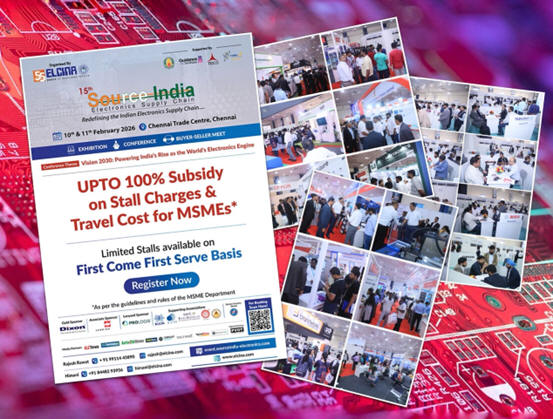
Source India
is ELCINA’s premier annual event
connecting India’s electronics supply chain, driving local
sourcing, investments, and innovation across consumer
electronics, automotive, EVs, defence, medical devices,
embedded systems, and smart technologies.
Theme 2026 – Vision 2030:
Powering India’s Rise as the World’s Electronics Engine
Join 5,000+ decision-makers, 150+ exhibitors,
and industry leaders at the 15th edition on 10–11 February
2026 at Chennai Trade Centre. Showcase cutting-edge
components, build strategic partnerships, and tap into
India’s fast-growing electronics manufacturing ecosystem –
aligned with ELCINA’s Vision 2030 to position India as the
world’s electronics engine.
Experience live demos, expert conferences, and high-impact
networking at Source India 2026. Secure your booth to boost
visibility, forge partnerships, and be part of India’s
electronics revolution.
Click here for details of Source India
2026
ELCINA Publications
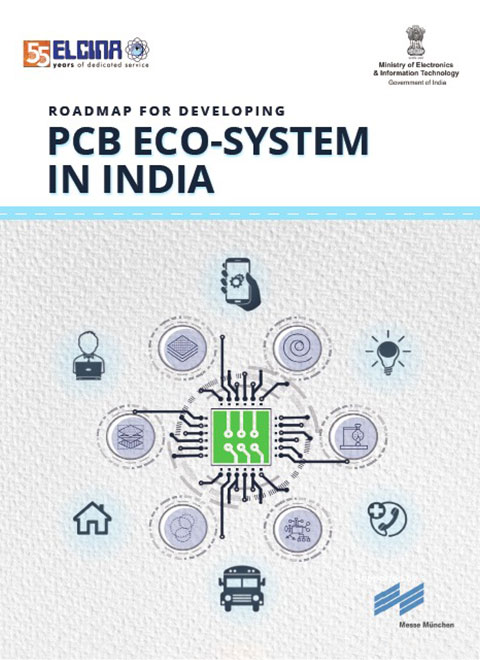
https://elcina.com/roadmap-for-developing-pcb-eco-system-in-india |
Roadmap For Developing PCB
Eco-System in India
Key Findings
-
Indian PCB market and industry size in terms of
domestic production, exports, and imports
-
Growth drivers and challenges (needs & gaps) in
the Indian PCB industry
-
Growth potential of PCB manufacturing in India
and identify enablers for creating &
strengthening the domestic value chain
-
Key inputs required viz. investments,
technology, and infra eco-system
Details of key PCB value chain players – global and
domestic, who can be invited to invest to establish
a strong PCB industry |
|
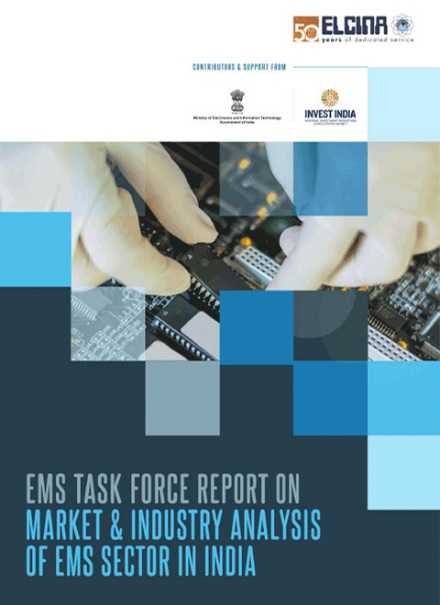
https://elcina.com/ems-task-force-report-on-market-industry-analysis-of-ems-sector-in-india |
EMS Task Force Report
Key Findings
-
Currently EMS Industry (Contract Manufacturing
Services) are valued 832 Bn $ and are projected
to grow 1055 Bn by 2025.
-
Domestic electronics manufacturing is estimated
at USD 75 Bn of which 39 Bn constitutes EMS
value. This is divided into 23.5 Bn domestic
Mfg. and USD 15.5 Bn PCBS/Sub-Assembly imports.
-
Further USD 53.5 Bn is finished Electronic Goods
imports of which USD 17 Bn is EMS value. Thus
total EMS opportunity loss is US$ 32.5 Bn (15.5
+17).
-
The report estimates that EMS production can
grow realistically from USD 23.5 Bn today to USD
152 Bn by 2025 at CAGR of 45%. This will meet
75% of the countries EMS requirement of US$ 203
Bn by 2025 against a total estimated market of
400 Bn.
|
|
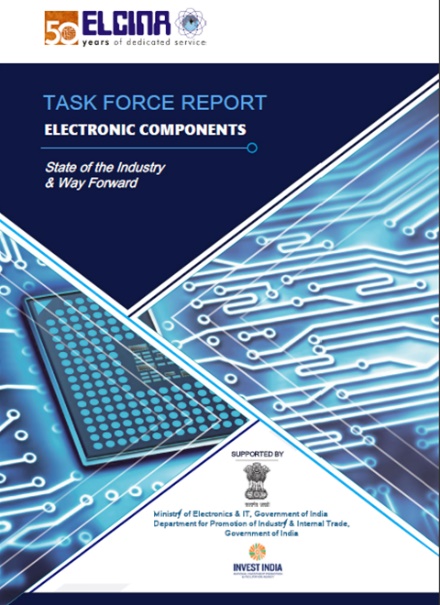
https://elcina.com/elcina-task-force-report-on-electronic-components |
ELCINA Task Force Report on
Electronic Components
Key
Findings
-
Current status of component manufacturing in
India – Areas of competence vs Gaps and
inadequacies
-
Components which urgently require investments
and growth in domestic manufacturing
-
Emerging technology and new components for
upcoming opportunities
-
Constraints and bottlenecks to be addressed
-
Overcoming Policy constraints, WTO (ITA-1)
deadlock and Zero Duty issue
-
Strategy for overcoming these constraints
-
Eco-System requirements- Role of Central and
State Governments
|
|

https://elcina.com/elcina-directory-of-indian-electronics-industry |
ELCINA Directory of Indian
Electronics Industry 2024-25
Description
-
ELCINA Directory of Indian Electronics Industry
– includes the updates on Indian Electronics
Industry and a host of additional improved
features covering business environment,
statistical industry scan, company databases
plus various projections. This handy compendium
with its easy-to-read format attracts the
attention of a growing number of users (within
India and abroad)
-
Apart from electronics industry, the users of
this Directory range from financial
institutions, commercial banks, FIIs,
Consultancy organizations as well as industry
promotion institutes across the world….
|
TOP
FORTHCOMING EVENTS & GENERAL INFORMATION
|

|
15th Source India 2026
10-11 February 2026, Chennai
Source India is ELCINA’s annual
electronics sourcing and manufacturing event,
scheduled for 10–11 February 2026 in Chennai. It
brings together stakeholders from across the
electronics supply chain to discuss sourcing,
manufacturing capabilities, and industry
developments across multiple electronics sectors.
Click
here for details |
|
|
Elecxpo India 2026
20-23 February 2026,
Chennai
Elecxpo India 2026 is an electronics
industry exhibition that brings together
manufacturers, suppliers, and solution providers
across components, systems, and manufacturing
technologies. The event focuses on developments in
electronics production, supply chains, and emerging
technology applications in the Indian market.
Click here for details
|
|

|
Mobile World
Congress (MWC) 2026
2-5 March 2026, Barcelona, Spain
MWC 2026 in Barcelona
will bring together stakeholders from across the
global telecom and technology ecosystem to discuss
developments in mobile networks, connectivity,
devices, and digital services. The event is expected
to focus on areas such as 5G evolution, early
discussions on 6G, enterprise connectivity, and the
broader impact of digital infrastructure on
economies and society.
Click here for details
|
|

|
S33rd Convergence India 2026
23-25 March
2026, Bharat Mandapam, New Delhi
The 33rd Convergence
India 2026, co-located with Smart Cities India 2026,
will cover a wide range of ICT and technology areas
including 6G, AI, IoT, fintech, blockchain, cloud,
cybersecurity, space tech, mobility, media, and
smart infrastructure. It will feature live
demonstrations, B2B meetings, conferences, awards,
and a startup hub with over 250 emerging companies.
Click here for details
|
|
 |
Embedded Tech India Expo 2026
23-25 March 2026,
Bharat Mandapam, New Delhi
Embedded Tech India
Expo 2026, organized by Exhibitions India Group, is
India's leading platform for embedded systems
developers, uniting hardware, software, tools, EMS,
OEMs/ODMs, manufacturers, distributors, academia,
and stakeholders from March 23-25 at Bharat Mandapam,
New Delhi.
Click here for details
|
 |
Productronica China 2026
25-27 March
2026, Shanghai, China
Productronica China
2026 will be held from 25–27 March 2026 and will
focus on technologies and solutions across the
electronics manufacturing value chain. The event
will cover areas such as electronic production
equipment, testing, inspection, and smart
manufacturing trends shaping the industry.
Click here for details
|
 |
Electronica India 2026
8-10 April 2026, India Expo Centre &
Mart (IEML), Greater Noida
The April 2026 North
edition of Electronica India in Greater Noida at
IEML will feature exhibition sectors from automotive
to wireless technologies, drawing exhibitors and
visitors for sourcing, networking, and innovation
showcases.
Click
here for details |
 |
Productronica India 2026
8-10
April 2026, India Expo Centre & Mart (IEML), Greater
Noida
Productronica India,
to be held in April 2026, will highlight dynamic
sectors like power electronics and manufacturing
innovations, responding to shorter sourcing cycles
and regional demands.
Click here for details |
TOP
|
A newsletter published by ELCINA, New
Delhi. The information contained in this newsletter
is for private circulation only. Despite our best
efforts, some errors could have crept in. You are
advised to verify authenticity of the information
before further use.
Electronic Industries Association of India (ELCINA
)
ELCINA House, 422 Okhla Industrial Estate,
Phase-III, New Delhi 110020 (India).
E-Mails:
info@elcina.com
Tel: 011-41615985,
41011291,
Website:
www.elcina.com
|
|